

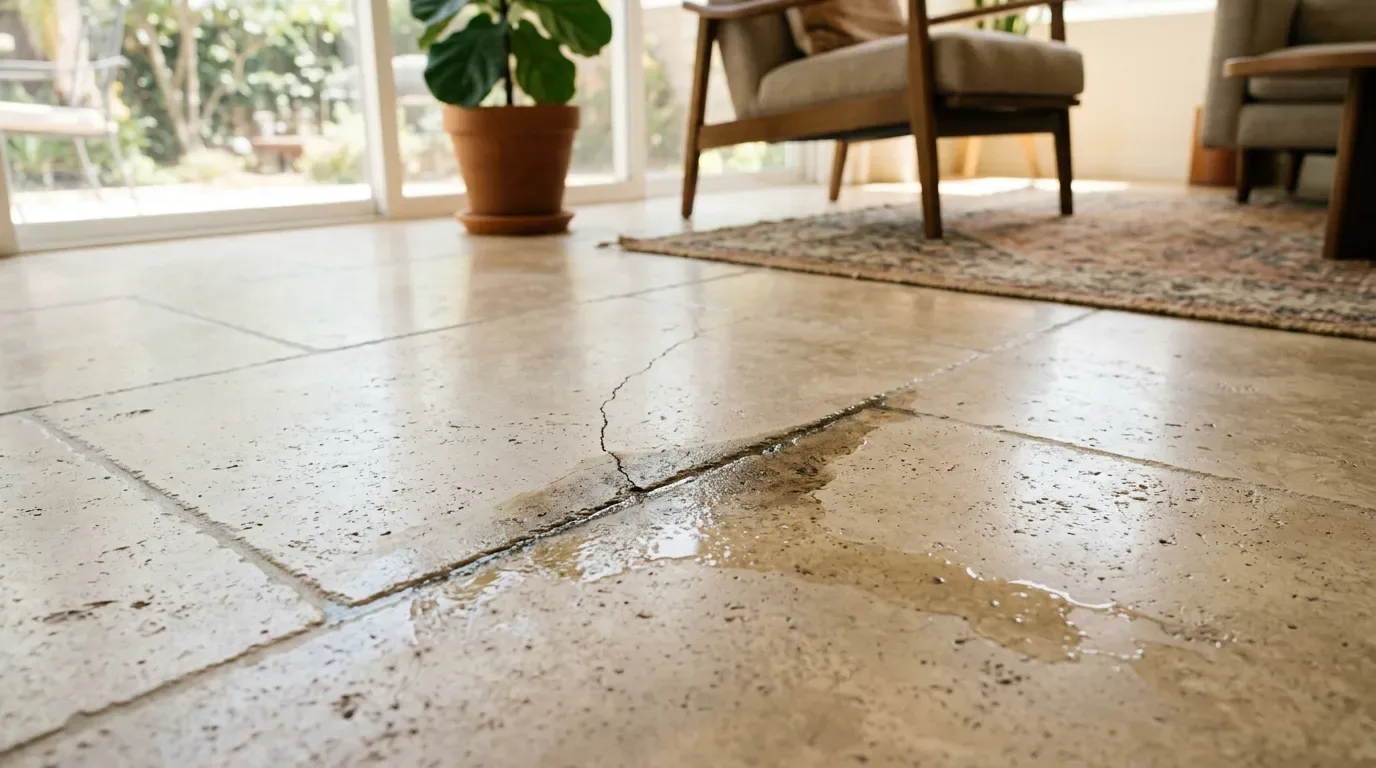
A water leak under a concrete floor is one of the hardest problems in a home or a commercial building. Without special equipment it is almost impossible to find. The consequences can be serious: high humidity, mold, damage to the structure and large water bills.
A pipe under the slab can fail for several reasons. Materials age, lose strength and crack. Pipes get damaged during installation or by accidental impact. Poor workmanship or the wrong materials play a part, and so does excess pressure in the line. Joints and fittings are a weak spot. Below are the signs of a slab leak, a simple meter check you can do yourself, and what usually happens next in a La Mesa house.
Signs of a Slab Leak
You can suspect a leak under the concrete by these signs:
- A water bill that goes up for no reason. The meter shows more use than usual, and nothing in the household has changed.
- Damp spots on the floor or walls. Stains on the flooring - laminate, wood, tile - or carpet that stays damp in one place.
- The sound of running water with all taps closed. Gurgling or trickling under the floor can point to a pipe that has lost its seal.
- Warm spots on the floor. This is typical when the leak is on a hot water line.
- Mold or a musty smell. Humidity in the room stays high.
- Cracks in the concrete floor or in the tile. Flooring can also warp or swell.
- A small drop in water pressure. Taps across the house run weaker than they used to.
None of these signs alone tells you where the pipe is broken. A warm spot, for example, can mean a hot water leak or simply a sunny spot on the floor. But two or three of them together are a reason to check further.
Signs of a Slab Leak in the Bathroom
The bathroom and the kitchen are where most supply lines run under the floor, so the symptoms of a slab leak often show there first: grout that changes color or stays wet, tile that lifts, a damp patch low on the wall near the tub. Under vinyl plank, linoleum and similar coverings a wet spot is hard to notice at all. Before you blame the slab, rule out the toilet. The EPA WaterSense leak-check guide suggests putting a few drops of food coloring in the toilet tank; if the color shows up in the bowl within 10 minutes, the flapper is leaking, not the pipe under the floor.
The Meter Test
Meter readings will not show where the leak is. They will confirm that there is a problem with the pipes. The EPA WaterSense method is simple:
- Stop all water use. Close every tap, make sure the washer, dishwasher and irrigation are off, and that no toilet is refilling.
- Write down the meter reading. Look at the dial or the digital display.
- Wait two hours. Use no water at all during this period.
- Read the meter again. Any change suggests a leak.
If the meter keeps moving while all water in the house is shut off, the leak is hidden somewhere in the system. At this point it makes sense to call pros with leak detection equipment.
How to Find a Water Leak Under a Concrete Slab
Some signs you can notice yourself, but to locate the leak exactly, especially under a slab, pros are needed. Searching on your own often ends with floors and walls opened in the wrong places. Slab leak detection usually relies on several methods.
Thermal Imaging
A thermal camera picks up temperature differences on the floor surface. The areas over a cold water leak are colder than the surrounding floor; over a hot water line they are warmer. The method makes it possible to find the leak without breaking the floor, though it needs a large enough temperature difference to work.
Pressure Testing
A pressure gauge is connected to the plumbing with all taps closed. A drop in pressure points to a leak. The test also helps to tell whether the hot or the cold line is leaking. Shutting valves one at a time narrows the problem down to a single branch.
Acoustic Leak Detection
An acoustic leak detector picks up the noise of escaping water that a person cannot hear, even through a concrete slab. It works best when water is leaving the pipe under pressure.
Moisture Meter and Video Inspection
A professional moisture meter measures moisture at depth. This helps to tell surface dampness from a deeper leak. A miniature fiber-optic camera can be fed inside the pipe to look at it from within; cracks, blockages and damage become visible.
How the Search Goes, Step by Step
So how can you detect a leak under your concrete floor if you hire it out? The process usually looks like this:
- Clear the room. Appliances and furniture standing over the pipe runs are moved, along with anything that gets in the way of inspecting the floor.
- Turn the water back on. If the water was shut off, it is turned on for the test.
- Study the plumbing layout. If there is no drawing of the pipes, they are traced first - their position and depth - with tracing rods and thermal equipment.
- Search with several tools at once. The thermal camera shows temperature contrasts, the scanner shows the location, and the moisture meter helps to judge the depth of the leak.
- Open only the spot that was found. The covering is opened at that point, the damaged section of pipe is removed and replaced with new parts.
A professional search often makes it possible to repair the leak locally, without pulling up the whole floor or relaying the main line.
If you find a leak, shut off the water supply right away, keep away from the wet area, and turn off power to the wet zone at the breaker panel only if you can reach it without stepping in water. Do not try to repair the pipe under the slab yourself - leave it to a licensed plumber; a DIY attempt can make the situation worse.
Slab Leak Repair Options
The repair method is chosen for each case after the inspection. The usual options are these.
- Spot repair. The slab is opened over the leak, the damaged section of pipe is cut out and replaced. If a fitting has lost its seal, it is tightened or the seal is replaced. If the problem is excess pressure in the line, a pressure regulator is installed.
- Reroute. The flow is redirected along a bypass route, and the old line under the slab is taken out of service. This can be a temporary step or a permanent one.
- Repipe. When old pipes are badly corroded or narrowed and the wall of the pipe has become thin, it no longer holds the pressure and starts to drip in new places. Then the whole problem section is replaced, not one spot.
Can You Fix a Slab Leak Without Digging?
In some cases, yes. Trenchless methods repair the pipe from the inside, through small access openings, without removing the slab. This often means less cost and less dust. Diagnosis is done with mini cameras and a thermal camera, then the access point and the scope of work are chosen.
- Epoxy injection. Used for cracks and seams.
- Sleeves and flexible liners. For local defects. A resin-soaked liner is put into the pipe and cures, usually over several hours, and then the line is tested for leaks.
- Cured-in-place lining. A liner that hardens with heat or ultraviolet light inside the pipe. It suits long and complicated runs; the diameter shrinks only slightly.
The order of work: first inspection with photos, locating the leak, preparing access and cleaning the pipe, installing the sleeve or injecting resin, curing and pressure testing, documentation. Temporary measures - a sleeve on a local crack, a plug at a joint, chemical injection for hairline cracks - are limited in time. Once things are stable, a permanent repair should be planned.
The Water Damage a Slab Leak Leaves
Finding and fixing the pipe is half the job. The water that came out of it stays in the slab and the finishes. Remove the moisture and dry the floor and walls in the leak area - this is how mold and a musty smell are avoided. The slab is dried naturally or with special equipment.
- Flooring. Laminate, carpet and pad soak up water from below, stain, warp and swell.
- Baseboards and the bottom of the walls. Damp patches appear low on the walls, and the drywall behind the baseboard holds water. For what water does inside wall cavities, see our guide to water damage behind walls.
- Mold. Mold on the walls can itself be a result of a leak under the floor. Our article on telling black mold from mildew explains what you may be looking at, and the mold remediation services page covers removal.
Drying, removing wet materials and restoring the rooms after the plumber is done is covered on our water damage restoration services page.
Are Slab Leaks Covered by Insurance?
It depends on the policy, and the answer comes from your insurer, not from the contractor. Many policies treat the pipe repair itself and the water damage it caused differently, and some cover access to the pipe - opening and restoring the floor - while others do not. Photo and video records of each stage, from the first damp spot to the finished repair, are useful for the insurer, so take them before anything is opened.
Prevention
To keep a leak from coming back, check the system regularly, keep an eye on the water pressure, and use quality materials. Keep a drawing of where the pipes run under the floor - it saves time and spares the floor when something goes wrong.
If you want to know who we are, read about our La Mesa restoration team or see what local homeowners say in reviews. More articles are on the news and tips blog, and everything we handle is listed on the water damage restoration home page.