

Faulty wiring, switches and outlets are a common cause of house fires. To check them, it is enough to call an electrician. But breaking the rules for setting up and using electrical equipment is also a frequent cause of fires. In real life, extension cords start fires too, and a space heater plugged into the wrong cord is a classic example.
When cold nights come, many people turn on extra heating devices. If the fire safety rules are not followed, these devices can cause a fire. To avoid trouble, it makes sense to take a combined approach: pay attention not only to choosing the equipment but also to using it correctly, and to the general condition of the home. Below we explain where the space heater fire risk comes from and how to keep a cold night in La Mesa from turning into a call to a fire damage restoration team.
Why a Space Heater Can Catch Fire
Space heaters are usually ceramic fan heaters, oil-filled radiators or infrared units, used to warm one room.
The harder you need to heat the rooms, the higher the danger of fire. Often, the fire starts because the heating device overheats.
If the heater is set up correctly and nothing covers it, the hot airflow spreads through the room. But if the device is covered or knocked over onto the floor, air circulation stops and the heat is "locked" inside. Parts of the device and the wiring get red-hot, and ignition follows.
So yes, a space heater can catch fire. It needs heat that has nowhere to go, or something that can burn standing too close.
The 3-Foot Rule
The U.S. Fire Administration heating fire safety page gives a simple rule: keep anything that can burn at least 3 feet away from heat sources, including space heaters. Curtains, furniture, bedding, paper, boxes all count.
The heater itself must stand on a flat, stable surface. Do not use it to dry things. Also, it is not recommended to use heaters in the bathroom, the kitchen or in rooms with high humidity if the device is not designed for such conditions.
- Do not cover a running heater. Do not put clothes, rags, boxes or anything else on top of it. It is especially dangerous to put wet things on it to dry. In that case a fire can start because moisture gets on the electrical parts.
- Give it free space. There must be enough room around the heater for the heat to spread. Do not lean it against a bed or box it in with furniture on all sides.
- Keep the room uncluttered. Do not put the heater in cluttered rooms, near curtains or furniture. The device can overheat and ignite.
- Clean off the dust. Dust on the heater can catch fire too.
- Keep heavy things off the cords. Do not put furniture or other heavy objects on the wires, so a spark does not happen.
Plug It Straight Into a Wall Outlet
Using any electric heater calls for strict rules: you cannot use damaged appliances and outlets, and you should not connect several high-wattage appliances through an extension cord at the same time. This is how you avoid overloading the circuit and heating up the wiring. Space heater safety tips almost always come down to this point: the heater goes into a wall outlet, by itself.
The reason is the extension cord. Extension cords can spark, heat up, melt and catch fire. Often this happens not because the cord is faulty, but because it is used the wrong way.
If the cord will not reach, move the heater, not the cord: the U.S. Fire Administration advises against using extension cords with appliances.
When unplugging appliances, hold the plug itself, not the cord. That way you do not damage the insulation of the wire.
Tip-Over and Overheat Shut-Off
When choosing a heater, preference should go to certified models with a recognized safety listing that have automatic shut-off for overheating and tip-over. For constant heating of living rooms, oil-filled heaters are often considered the safest. For quick local heating you can use fan heaters or ceramic heaters, but it is important to make sure they are in working order and of good quality. Avoid buying outdated open-coil models and devices from unknown manufacturers without a factory warranty.
When choosing a heater, pay attention to the extra functions:
- Auto shut-off. After heating up to a certain temperature, the device turns off.
- Thermostat. When the room gets cool, the device switches on, and when the temperature rises to the set value, it switches off.
- Timer. You can set a delayed start and a shut-off time.
Check that the heater has overheat shut-off. If there are children or pets in the house, buy devices that turn off automatically when they fall over. The switches in such devices usually work on a simple principle and do not always trip, but with them it is still better.
Turn It Off When You Leave the Room or Go to Sleep
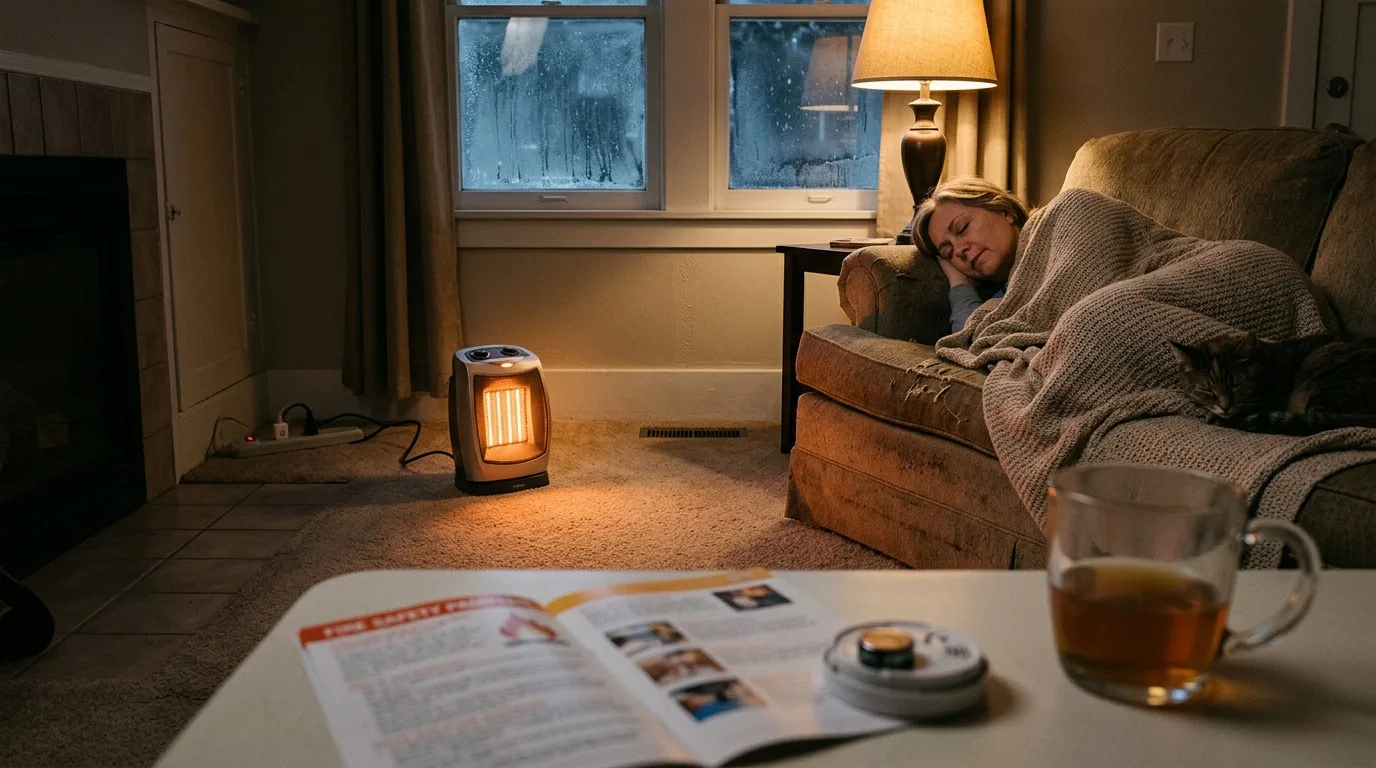
The U.S. Fire Administration advice is direct: turn space heaters off when leaving the room or going to sleep. An electric heater must not be left plugged in and running unattended, especially overnight. Do not turn electric heaters on for the night and do not leave them unattended.
Never leave a space heater running in an empty room or while you sleep. Turn it off every time you walk out or go to bed. Most of the other rules only lower the risk; this one removes the hours when nobody would notice a fire starting.
The same goes for children. Toddlers try to touch everything they can reach, so always switch off devices after use and do not let children near them while they are running.
Warning Signs of Space Heater Fire Hazard
Often, before an open flame appears, an object heats up strongly or begins to smolder. There is a smell of burnt plastic, wood or fabric, depending on what is burning. Smoke slowly builds up in the room. If the lights go out or burn dim, and the air smells of burnt rubber, the wiring is burning.
If the place where the fire started is well ventilated, people in the next rooms may not even smell anything or see smoke. But if you suddenly hear wood crackling, sometimes with whistling sounds, there is a fire in the house.
Signs to watch for while a heater is running:
- A hot cord or plug. The cable should not get very hot. If it feels hot, the load is too high.
- Sparking. With a strong or frequent bend in a cable, the insulation can be damaged, and an electric arc may appear. The cable then starts to spark like a sparkler. This leads to melted wire and a fire.
- A loose plug. A plug that wobbles in the socket makes poor contact and can cause a fire.
- Old appliances. Wire insulation ages along with the devices, so they can easily spark, disturb the circuit and start a fire.
Do not forget to look over switches, outlets and appliances from time to time for faults and for intact wire insulation. It is better still to call an electrician who can find all the weak spots at once.
If the Heater Catches Fire
Open fire spreads quickly, so act fast: you have very little time to stop a fire that is just starting. If you cannot put out the flame right away, leave the home. Acting on your own after that is very dangerous. Call 911 from a safe place.
- Cut the power first. If the cause of the fire is an appliance that is switched on, it must first be unplugged or switched off, if that can be done safely. Only then can a small fire be put out, ideally with a fire extinguisher. A large fire is for the firefighters.
- If you cannot cut the power. Then use only a fire extinguisher rated for electrical fires, never water.
- Close doors behind you. If possible, close the doors behind you as you leave, so the fire gets less oxygen.
- If it does not go out right away. Leave right away, warn the neighbors and wait for the firefighters. Move crouched or even crawling, so you breathe in less smoke.
Buy a household fire extinguisher. It deals quickly and well with a small fire.
After a Small Fire: Soot and Smoke Residue
Even when the fire was put out in a minute, the heater, the cord and the outlet it was plugged into need checking before anything goes back on. It is best to call an electrician to look at the wiring and the equipment. Damaged devices and outlets cannot be used.
Soot and smoke residue settle beyond the spot that burned, on walls, ceilings, furniture and fabrics. If there was a lot of smoke, or the smell stays after airing out the rooms, a professional fire and smoke cleanup is the safer route than scrubbing alone. Belongings that need cleaning away from the room can go through pack-out and contents cleaning. If water was used to put the fire out and soaked the carpet or drywall, it needs drying after water damage, otherwise wet materials can lead to mold growth and remediation work later.
You can read more about our La Mesa team, see what local customers wrote in reviews, or go back to our restoration services home page. More home safety notes are in the blog's latest articles.