

A pot stayed on the stove ten minutes longer than it should have, or in the evening smoke drifted in through a cracked window. An hour later the burnt smell is not only in the kitchen but in the hallway, in the curtains and in the clothes on the hanger. You open a window and it gets better; you close it and the smell comes back.
A burning smell in the house but no fire usually has one of a few different sources, and each one has its own solution. Below we go through how to tell where the smell comes from, when it is a reason to call 911, what to do if it smells like burnt wiring, why a heater smells on its first run, and what to do if the smoke comes from outside.
When a Burning Smell Is a Reason to Call 911
First, the main thing: a burning smell can be a sign of a fire that is not visible yet. It makes sense to search the house for the source only when you know for sure what burned, for example food on the stove, and the fire is already out.
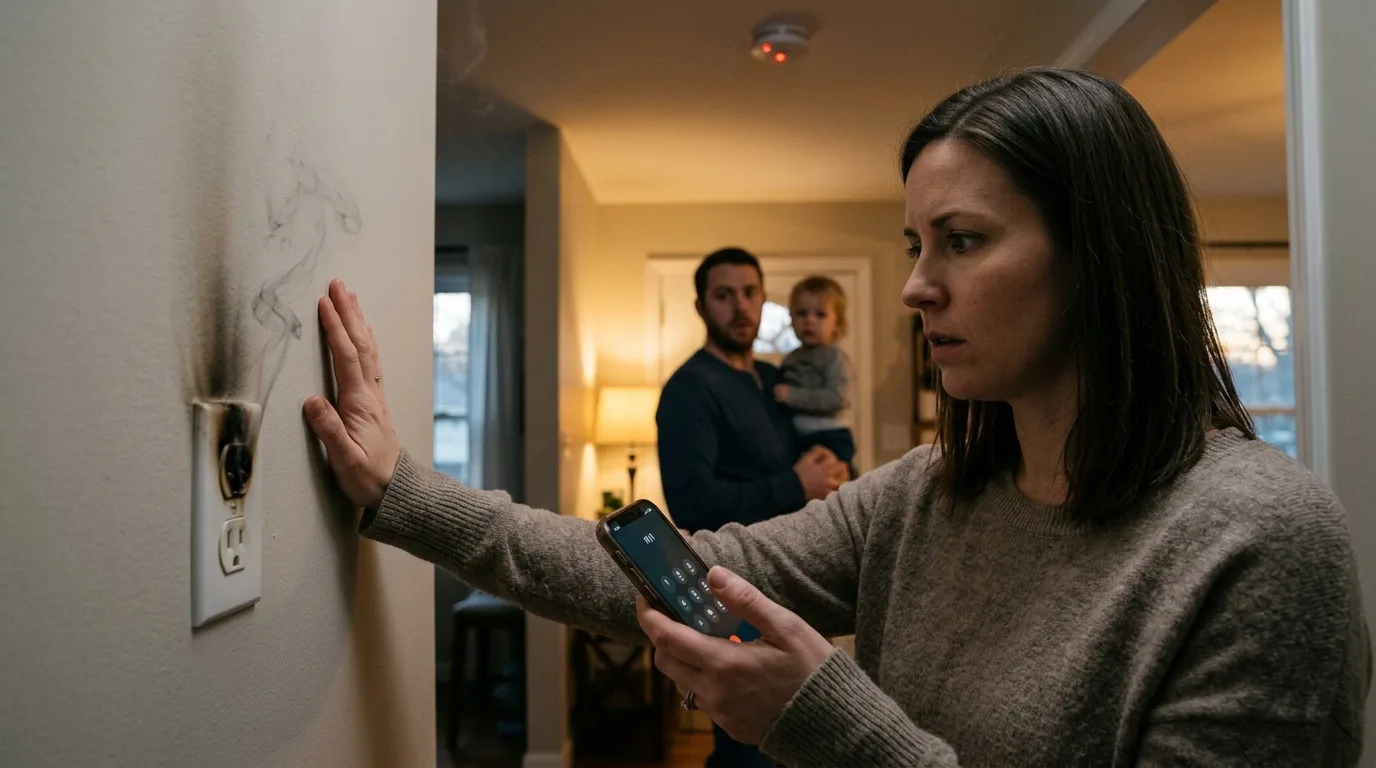
Call 911 right away, without trying to figure out the cause, if you see flames or smoke and do not know where it comes from, or if it smells of burning insulation or plastic, especially near outlets, switches or the electrical panel. If you smell gas, do not turn lights or appliances on or off and do not use open flame; if it is safe, open the windows, then get out of the house and call from outside.
Other signs that should not wait:
- Hot plugs and cords. An outlet, a plug or an extension cord is hot to the touch, with dark spots or traces of melting.
- Smoke in shared spaces. Smoke or a strong burning smell in the stairwell or the hallway of the building.
If the smell is coming from an appliance, cut its power first: pull the plug or switch off the breaker at the panel if the outlet has heated up. It is not worth turning the appliance back on until a technician checks it: burnt insulation does not go away on its own.
A burning smell for no visible reason is not a reason to open a window and forget about it. Until the source is found, treat it as potentially dangerous.
Electrical Fire Smell: Outlets, Switches and Wiring
If you smell burning wiring, shut off the power at the panel if you can reach it safely. If the smell is near outlets, switches or the panel, or you cannot find the source, leave the house and call 911: a fire inside a wall may not show yet.
How to Tell the Wiring Is Overheating
Wiring rarely bursts into open flame all at once. More often it gives signs for several days or weeks, signs that are easy to blame on something else. The smell is particular: not smoky like food, but sharp, chemical, like burning plastic.
- The smell appears under load. It shows up when powerful appliances are on: a kettle, a heater, a washing machine, an oven.
- Warm outlets. An outlet or switch is warm with a small load or with no load at all.
- Flickering lights. The light flickers or dims when an appliance turns on.
- A loose plug. The plug sits loosely in the outlet, sparks when plugged in or crackles.
- Dark marks. Dark spots have appeared on an outlet, a switch or an extension cord.
An outlet that heats up or smells is shut off at the panel and not used again until it is checked. Replacing it and checking the wiring should be done by an electrician: if the cause is a bad contact inside the wall, a new outlet over the old wiring will not solve the problem.
A separate common cause is extension cords and power strips with several powerful appliances plugged in at once. A heater and a kettle on one extension cord is a typical path to overheating, especially at the start of the cold season. The U.S. Fire Administration electrical safety sheet covers the same warning signs.
Finding the Source After the Power Is Off
After shutting off the power, you need to try to locate the source of the smell. Where it smells strongest, that is where the source is. This is needed so you do not check the whole house but search in a specific place. Appliances are checked first; faults are often in them. If the smell is coming from an appliance (and all the more so if you see a wisp of smoke), you simply unplug it and turn the power back on. That appliance cannot be used anymore; it has to be either repaired or thrown out and replaced.
If it is not an appliance, then the wiring itself is checked. Here an electrician looks not only at the wires but also at outlets, switches and junction boxes. Very often the problems are with them, especially with old outlets. If the problem is in an outlet or a switch, you could say you were lucky: you found the fault quickly. If it is not them, the wires themselves remain, and here everything is much harder, especially if the wiring runs inside the walls. In that case a visual check is not possible, special instruments are needed, and the best thing is to call an electrician.
Ideally, of course, it should not come to the point where you have to search for the source of the smell at all. For that, all the wiring should be good quality, done to code, with circuit breakers installed, and rated for the loads. If it is already very old, it needs to be replaced. Yes, often nobody wants to do this, since it is not exactly cheap or simple, but a fire will cost much more. Wiring that is decades old was not designed for today's number of appliances, and 30 years or more will affect the condition of the wiring in any case. For some reason many people underestimate this, and it is one of the most common causes of fires.
Burning Smell From a Heater or Furnace on the First Run of the Season
The smell from an electric heater comes from two fundamentally different causes: either it is the normal burning off of settled dust and factory protective coatings, or it is emergency overheating of the conductors and insulation. In the first case, a light technical smell is not a threat and clears in 10-30 minutes of airing out. If you smell the sharp odor of burning plastic or melting rubber, or see bluish smoke and sparks, the appliance is a direct fire risk and has to be switched off immediately.
Dust and Factory Grease
Over months of sitting idle, a layer of household dust, textile lint and pet hair settles inside the housing. When the heating element warms up to working temperature, these organic particles start to smolder and char. This gives the typical smell of burnt dust. The situation is safe if there is no bluish smoke, the housing is not deforming, and the smell itself clears completely within the first 15-30 minutes of warming up.
A new heater almost always smells of factory chemicals or machine oil. At the production stage, metal heat exchangers and heating element fins are treated with protective oil compounds to prevent corrosion during shipping and storage. A light chemical smell when unpacking is a normal step of putting it into service.
Many people know the same thing from the first days of the heating season: a furnace burns off dust that settled in it all summer. The smell is unpleasant but short. If it lasts more than a couple of days or grows stronger, look for another cause.
Signs the Heater Has to Be Switched Off
- Hot PVC near the plug. A noticeable sharp smell of heated insulation near the plug or on the back of the unit points to serious electrical problems: loose terminals, house wiring too thin for the heater's high load, or worn spring contacts in the outlet.
- Burning plastic smell. It means dangerous overheating of internal modules or the outer housing. In most cases this happens because the bottom intake or top outlet vents are blocked, the unit was covered with thick fabric or clothes to dry them faster, or the space between the fins is clogged with a felted layer of hair and dust.
- Clicking, sparks, smoke. A sharp, choking smell of acrid burning with clicking, showers of sparks, voltage drops in the house or smoke is a sign of a short circuit inside the housing. Taking the unit apart while it is live is dangerous; it should be cut off at the breaker in the panel immediately.
What to Do When the Smell Appears
- Turn it off and unplug it. Press the off button and pull the plug from the outlet. Hold the plug by its base, do not pull on the cord.
- Air out the room. Open windows and doors. A draft quickly removes the products of burnt dust or overheated plastic.
- Inspect the housing, cord, plug and outlet. Look for darkening, melting, the smell of hot plastic or soot around the outlet holes. Cheap adapters are often the first spot to heat up.
- Stop if it smells of plastic. With a smell of burnt plastic or melting wiring, the unit cannot be used. Do not turn it on until the cause is fixed.
- Let it run if it is just dust. If it smells of ordinary burnt dust after long storage, run the heater at moderate power in a ventilated room for 20-30 minutes.
- Get it serviced if it repeats. If the smell does not clear or the housing gets very hot at the contacts, take the unit to a service center.
Burning Plastic Smell From Other Appliances
A similar short smell comes from other appliances that have not been turned on for a long time. A new oven, like a new heater, burns off factory grease and protective film on its first run. An air conditioner after a long break may smell of dust and dampness rather than burning: if the smell is definitely burnt, the unit is switched off and a technician is called. A hair dryer, an iron, a toaster with something burnt onto the heating element is another source people forget about.
Sometimes a burning smell appears every time you cook, even though nothing burned. Usually this is old burnt-on grease: on the bottom of the oven, on baking sheets, on the stove grate, on the range hood grease filter. When heated, it starts smoking again.
Smoke Smell in the House From Outside
To tell outside smoke from smoke inside the home, one observation is enough: close the windows and sit for 15-20 minutes. If the smell gets weaker, the source is outside. If it stays the same or grows, it is inside the house or at the neighbors'.
In a city this is most often fireplaces, fire pits and barbecues, and in dry weather wildfires, sometimes hundreds of miles away. Outside smoke is unpleasant not only because of the smell. It carries fine soot particles and combustion products, and during long periods of smoke they get into the home through open windows and gaps. People with asthma, heart and lung disease, pregnant women, children and older adults are advised to spend less time outdoors and keep windows closed when the smoke is heavy.
- Close the windows when the smell is stronger. Most often this is evening and night: in calm weather the smoke stays low to the ground.
- Air out briefly with a cross-draft. Do it when the wind has changed and the smell outside has eased.
- Wipe with a damp cloth. Soot settles on windowsills and floors.
- Watch the forecast. Follow reports of smoke in your area.
Closed windows are a good measure for an hour or two. For a week of smoke they are not enough: in a closed home it gets stuffy overnight, so run a portable air cleaner or the HVAC system with a good filter.
Smoke Odor Afterwards
The smell stays not in the air but on surfaces. If a burning smell is still there after a day of airing out, the problem is fabric and residue, not ventilation. Burnt food gives off thick smoke, and its particles settle on everything they reach: walls, curtains, furniture, clothes. You change the air in the home in half an hour, but the smell will keep coming back from fabric and surfaces for several more days.
- Wash the textiles. Curtains, kitchen towels, covers and tablecloths hold the smell longest.
- Wash the surfaces. Cabinet fronts, walls near the stove, the windowsill, the range hood itself and its grease filter. A thin sticky film stays on them, and that is what smells.
- Do not mask the smell. Air fresheners and candles add their own substances to the air, and the burnt smell stays underneath.
After a fire in a neighboring unit or in the building, a burning smell lingers for weeks. Smoke travels through shared ducts and stairways, and soot settles in air ducts, on walls and inside homes with windows and doors left open. Household cleaning is usually not enough here: soot works its way into porous materials like drywall, plaster, upholstered furniture and carpets. This is the stage where fire and smoke damage restoration comes in, and belongings that need cleaning off-site go through contents pack-out and cleaning. Where a fire was put out with water, water damage restoration and drying is part of the same job, and wet materials left too long can lead to mold remediation in the home.
Summary
- No visible cause is not a reason to relax. A burning smell in the house but no fire can be a sign of a fire. Flames, smoke, the smell of burning insulation, or burning together with gas is a reason to call 911 right away.
- Two clues find the source. Look at where the smell is stronger and when it appears. If it weakens with the windows closed, it is from outside.
- Power off first. With a smell of burnt wiring, shut off the power and call an electrician. Ignoring it can lead to a fire.
- The first days of heating are different. Dust burning on furnaces and heaters gives a short smell that goes away on its own.
- Fabric and surfaces hold the odor. Airing out helps, but without washing the smell comes back.
You can learn more about our La Mesa restoration team, read what local customers say about us, browse more fire and water safety articles, or go back to the restoration company home page.