

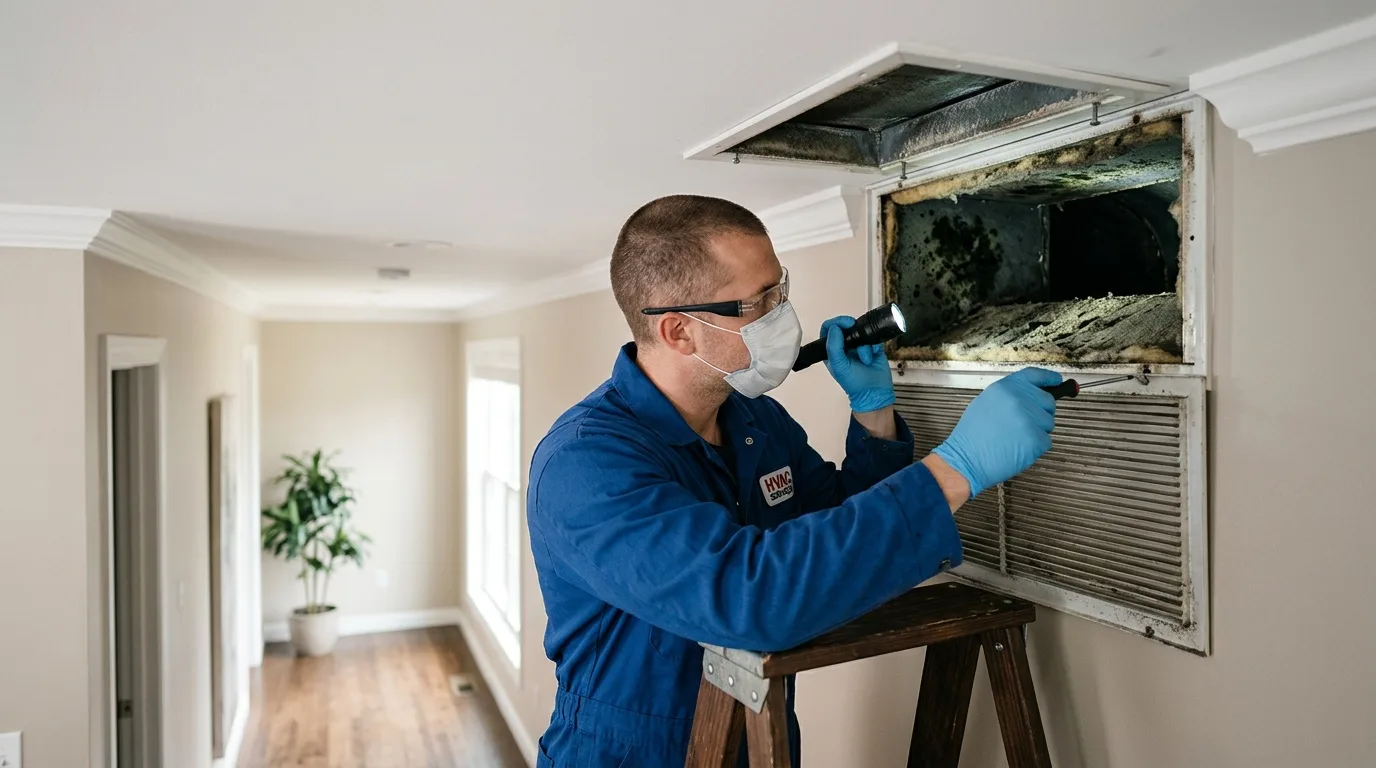
Most people check the walls, the corners or the bathroom when they think about mold in the house. Few suspect that it can grow for years in the ventilation ducts or in the HVAC system. That is exactly where the conditions are ideal: moisture, dust, warmth and no light. As a result, mold spores spread through the whole home along with the air you breathe every day.
If you pay no attention to the state of the vents, the problem can stay unnoticed for a very long time. People get allergic reactions or a cough, but do not connect it with the air quality in the house or the office.
The air we breathe indoors passes through a complex network of air ducts. If that system goes years without service, it turns into an incubator for everything we do not need to inhale. Dust, allergens, bacteria and, worst of all, mold spores circulate through the rooms.
Why Mold So Often Shows Up in the Vents
The main reason is a buildup of moisture and organic particles. Dust, grease, tiny bits of fabric and skin settle inside the ducts. Together with condensation, this makes a food source for mold.
Mold in vents most often appears because of:
- High humidity in the rooms;
- Infrequent cleaning of the vent grilles;
- Exhaust that doesn't work right;
- Clogged ducts.
Water from a leak can also end up in the system — a wet ceiling or wall over a duct run is one of the hidden signs of water damage behind walls worth checking.
Condensation: the main cause
The main reason mold appears in a duct system is condensation. If the system has sections with a temperature difference or poor insulation, moisture from the air settles on the walls of the duct and makes an ideal place for mold to grow.
Signs You May Have Mold in Your HVAC System
Sometimes the smell of mold in the house is noticeable only after the air conditioning or the exhaust fan is turned on. That is the first warning sign. A musty smell when the AC is on, one that gets stronger whenever the system runs, should not be ignored.
You should also be alert if you notice:
- A musty smell with no visible spots on the walls;
- Black or dark growth on the vent grilles and registers;
- Irritated eyes, nose and throat;
- Dust that builds up quickly after cleaning.
If the symptoms go away when you are away from home, the cause may be the air system itself.
There are obvious signs and indirect ones. The first is a lasting musty, dusty or odd smell that gets stronger when the system is switched on. The second is visual: if you take off a grille and see a thick layer of black dust or, worse, dark mold spots on the inside walls of the duct. Not every dark spot is mold, though — this guide on telling black mold from mildew can help you sort out what you're looking at.
Indirect signs are often blamed on other things: the people in the house have more allergic reactions; dust collects on surfaces quickly; the system works worse — a weak airflow at the same fan setting.
Mold in Air Ducts Symptoms: Why It's Dangerous
Mold in the air is dangerous because a person breathes in the spores all the time. They can cause:
- Allergic reactions;
- Breathing problems;
- Asthma flare-ups.
Children, older people and people with weakened immune systems are especially sensitive to mold.
What a Homeowner Can Check
Many people think that if they wipe the vent grille, the problem is solved. That is a dangerous mistake. Most of the dirt collects deep in the ducts, at the bends and branches, where a rag can't reach. A layered buildup forms there out of dust, grease deposits (especially near the kitchen), organic particles and moisture. This is not just dirt but food for microorganisms.
Ordinary cleaning removes only the top layer and leaves the biofilm — a community of bacteria and fungi that is firmly attached to the walls. They keep multiplying and release their by-products into the airflow. Without dealing with this layer, cleaning gives only a short-lived visual effect, and soon the smells and allergens come back.
On your own you can only clean the vent grille and the section of the duct right behind it. A full treatment of the whole system cannot be done without special equipment and know-how. Moreover, the wrong actions can push the contamination deeper or damage the duct. For an accurate picture, professionals use endoscopes with cameras that let them look several feet inside the duct and judge the size of the problem.
Flex vs. Metal Ducts
The material of the duct matters. The EPA's guide on air duct cleaning says cleaning is worth considering if there is substantial visible mold growth inside hard-surface (sheet metal) ducts or other parts of the heating and cooling system.
Insulated and flexible ducts are a different story: when duct insulation gets wet or moldy, it cannot be effectively cleaned and should be removed and replaced. Some cleaning methods also don't suit every type of duct — for example, high temperatures can damage some kinds of plastic or flexible corrugated sections.
How to Clean Mold in Air Ducts and Who Should Do It
If mold has already appeared inside the system, washing the grille will not help. In such cases it takes professional mold treatment, which includes cleaning the ducts, disinfection and removing the cause of the mold. A professional mold remediation service should deal with all three, not only with what can be seen.
The EPA notes that duct cleaning has never been shown to actually prevent health problems. So the reason to clean is visible mold growth, not a schedule.
Mechanical cleaning comes first
This is the basis of any process. Without good removal of the physical dirt, all the methods that follow work poorly. Flexible or rigid rotating brushes are used to break up and knock the buildup off the walls. At the same time, a powerful industrial vacuum with a HEPA filter pulls in everything loosened so it doesn't scatter through the rooms.
For complex and long systems, especially in large buildings, robotic units are used. They are controlled remotely, have cameras and can get through difficult runs. Mechanical cleaning is the most labor-intensive stage, but it cannot be skipped. Sometimes it works the other way round: people try to use chemicals right away, but they do not get through a thick layer of dust, and nothing changes.
Mold removal is a two-step process
Fighting mold is always a two-step process. First, the visible growth is removed mechanically with brushes and vacuum. Then a fungicide may be applied. Only products approved for use in ventilation systems should be used. Never use household chemicals — they can be toxic as they evaporate and can damage the duct material. Fumes from homemade mixes or bleach can circulate through the system and cause poisoning or allergies.
What to ask the contractor
The market for these services is very uneven. What matters is that the company has not only the equipment but an understanding of the process. A good pro always starts with a video camera inspection and gives a report on the state of the system. They should clearly explain which method will be used and why, and what products are applied. Before hiring anyone, it helps to read what local customers say in reviews and learn about the team doing the work.
- Dust collection: ask whether an industrial vacuum with a HEPA filter is used, so the dirt doesn't fly into the room.
- Before-and-after report: ask whether they provide one with photos.
- Safety data sheets: always ask for them for the products being used.
- Timing: be wary of anyone offering a "one-hour cleaning" for a large house or office. Good work takes time.
Mold in Air Ducts After Cleaning: Keeping It From Returning
If the source of the moisture is not fixed, mold will come back even after a good cleaning.
Removing growth is not enough. The cause has to be dealt with: insulate the problem sections of the ducts and adjust how the system works so there is no condensation. Without this, mold returns. If the moisture came from a leak or flooding, that water has to be dealt with first — that is the job of water damage restoration and drying.
Prevention is much cheaper and simpler than professional mold removal after a heavy infestation. What to do regularly:
- Keep humidity at 40–60%;
- Air out the rooms;
- Don't block the vents with furniture;
- Change or wash the filters.
A UV lamp mounted right in the duct, usually after the filter, is a preventive measure. Ultraviolet light of a certain range (UVC) breaks down the DNA of microorganisms, viruses and spores and keeps them from multiplying. It is not a way to clean heavy contamination once. The lamp works all the time, treating the air that passes and helping keep biofilm from forming on the walls. To kill an existing mold colony, mechanical cleaning and fungicide treatment are needed; the UV lamp only helps hold the result.
Mold in the ductwork is one of the most dangerous forms of contamination in a home, because it can't be seen and it spreads quickly through the air. Regular service of the ventilation system helps reduce the risks and keep the indoor air healthy. More articles on water, fire and mold are in our home restoration blog, and our La Mesa restoration company homepage lists everything we handle.