

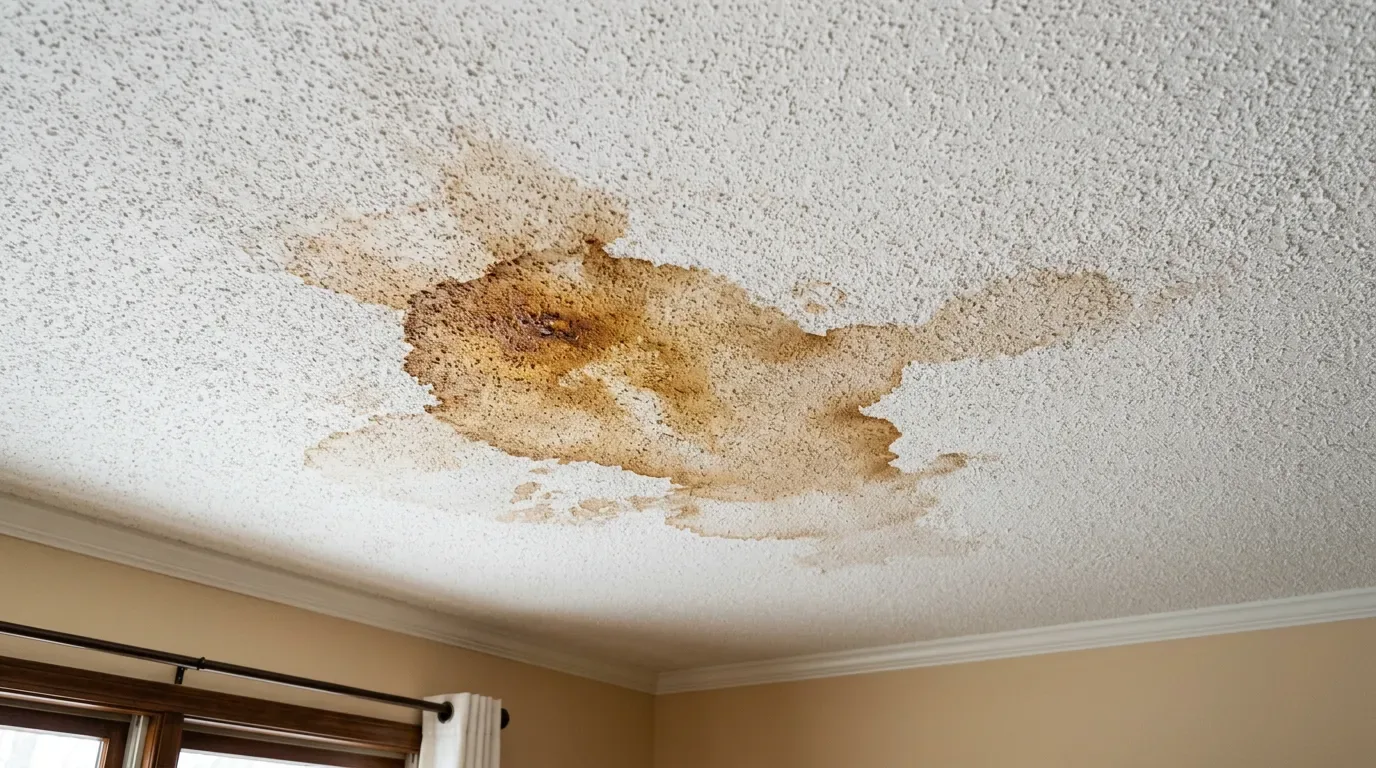
Asbestos, once considered a wonder material in construction, raises well-founded concerns today. Its properties, such as fire resistance, strength and low cost, made it a popular ingredient in many building materials for most of the 20th century. Unfortunately, these same properties led to serious consequences for human health, and that forced most countries to rethink its use and give it up.
Still, the substance creates problems even now, because people run into it when older buildings are demolished or renovated. A leak is one of those moments. When a popcorn ceiling in an older La Mesa home gets wet, the first impulse is to scrape the soggy texture off and start over. Below is why that impulse should wait, and what to do instead.
Why Older Textured Ceilings Are a Concern
Asbestos is a natural fibrous silicate mineral. It does not burn and it resists high temperatures and many chemicals. High elasticity and binding ability allowed it to be used in a large number of products, which are divided into firmly bound and weakly bound (friable) ones.
Products with firmly bound asbestos, such as asbestos-cement sheets, have a uniform, hard, grayish surface. Weakly bound products have a softer surface, and at a break or cut you can see bundles of fibers sticking out, with single fibers coming away easily. This group includes lightweight building boards, asbestos paperboard, and also asbestos-containing plasters, putties, adhesives and window glazing compounds. A soft textured ceiling finish belongs to the same family of coatings, and that is why an older popcorn ceiling is a concern.
Asbestos is a group of minerals under one common name. There are two main varieties:
- Serpentine (chrysotile) asbestos. Also known as white asbestos, it is the most common type.
- Amphibole asbestos (crocidolite, amosite, anthophyllite, tremolite and actinolite). These types are less common, but they are considered more dangerous because of their structure and their tendency to split into finer fibers that get into the airways more easily.
Why asbestos dust is dangerous
The main danger of asbestos is its ability to split into tiny fibers that easily get into the air and can be inhaled. Asbestos consists of microscopic fibers. Once in the lungs, these fibers cannot be removed from the body. They build up in the tissue and cause chronic irritation and inflammation. Over time this can lead to serious diseases.
- Asbestosis. A chronic lung disease that develops from long-term exposure to asbestos dust. Symptoms include shortness of breath, cough, chest pain and fatigue. In severe cases it can lead to respiratory failure and death.
- Lung cancer. Asbestos is a proven carcinogen. Inhaling asbestos fibers raises the risk of lung cancer considerably, especially in smokers. Asbestos and tobacco smoke together have a synergistic effect and multiply the risk.
- Mesothelioma. A rare and aggressive form of cancer that affects the lining of the lungs (pleura) or of the abdominal cavity (peritoneum). One of the main causes of mesothelioma is asbestos exposure. It has a poor prognosis and is hard to treat.
- Other conditions. Asbestos can also contribute to pleurisy, thickening of the pleura, ovarian cancer and cancer of the larynx. Research keeps finding new aspects of its harm to the body.
What Happens When a Popcorn Ceiling Gets Wet
As long as asbestos products stay intact, they usually do not pose a health hazard, since they do not release fibers. But if such materials become brittle, delaminate or break, they have to be dealt with by licensed professionals and in line with the applicable rules. Water is exactly what pushes a ceiling toward that state. Signs to look at:
- Sagging. A ceiling that has dropped in the middle calls for a check of the condition of the structure; keep people out from under it, and no repair should start until the results are in.
- Stains. A stain can keep spreading after the leak stops, and the wet area above the ceiling is often bigger than the visible spot.
- Falling texture. Pieces that crumble, peel or drop onto the floor are the brittle, delaminating, broken state described above. At that point fibers can end up in household dust.
Water rarely stays where you can see it. Our guide to hidden signs of water damage behind walls covers the places a leak spreads before it reaches the ceiling.
What Not to Do: Scrape, Sand or Dry-Sweep
Any work on asbestos-containing materials that involves mechanical processing carries danger: drilling, sawing, sanding, milling, crushing and so on. Scraping a wet popcorn ceiling with a putty knife is mechanical processing too.
Dry cutting, sanding or drilling of asbestos-containing materials should never be done. Even a short exposure to asbestos can be harmful to health, so do not scrape, sand or sweep a damaged textured ceiling until you know what it contains.
This applies not only to professional builders but also to ordinary people who can run into asbestos while repairing or taking apart an older building. A few practical points:
- Do not dry-sweep the debris. Work with asbestos should be done in conditions that keep the dust from spreading. Remaining dust in the work area is removed by wet cleaning of all surfaces.
- Do not use an ordinary vacuum. Asbestos dust is collected only with special HEPA vacuums built for asbestos work, which are cleaned inside and out after each use.
- Do not start dismantling on your own. Taking apart asbestos-containing structures yourself is not recommended, since it can lead to serious health consequences.
- Keep people out. The work area should be closed off so that dust does not travel through the rest of the home.
Testing: The Only Way to Know
Only an examination of the building materials shows for sure whether they contain asbestos. That is why such an examination before demolition, repair or renovation of buildings constructed many years ago makes sense.
Avoid mistakes in judging by eye. Asbestos-containing materials can be confused with materials made later from asbestos substitutes, for example fiberglass or mineral fillers. Caution is also needed with the insulation of heating systems and electric heaters, and with the door gaskets of wood stoves and fireplaces, since they can contain asbestos too.
The EPA's asbestos guidance for homeowners puts it this way: if building materials are damaged or will be disturbed by repairs, have them sampled by a trained and accredited asbestos professional. Taking samples yourself is not recommended. Material in good condition that will not be disturbed can be left alone.
For a water damaged popcorn ceiling, this usually means the damaged section has to be sampled before any drywall, patching or re-texturing work begins.
If the Test Comes Back Positive
Any work on taking apart, repairing or rebuilding parts of a building where asbestos was used should be done only by companies that have the special knowledge, equipment and personal protective equipment for it. In practice this means a licensed abatement contractor removes the material before drywall work on the ceiling starts.
How abatement work is done
- Binding the dust first. Only methods that keep fiber release to a minimum are used. Before a product containing asbestos is taken down, an agent that binds dust and fibers is applied to it. Wetting the surface with water also reduces the release and spread of fibers.
- Protective equipment. Depending on the concentration of fibers in the air, respirators with suitable filters that fully cover the airways are used, along with protective clothing and gloves. The respirator has to fit tightly to the face.
- Disposable suits. After leaving the work zone, a disposable suit is disposed of under the rules for hazardous waste. Reusable workwear is not recommended; if it is used anyway, it must be thoroughly decontaminated after leaving the hazard zone.
- Disposal. Asbestos-containing waste is handled under federal, state and local waste rules and taken to sites set aside for it. Items in the hazard zone that cannot be cleaned are also treated as hazardous waste.
That last point is a reason to get furniture and belongings out of the room before work starts, or at least to cover them with reliable covers. If the room is full, pack-out and contents storage services move things out of the way first.
Drying Above the Ceiling
Before any work, the main thing is to find out why the ceiling got wet. There is always a reason. If it is not eliminated, the same trouble can come back after the repair.
The order of work for a ceiling after a leak looks like this:
- Preliminary inspection. The goal is to find defects that are hard or impossible to fix on your own, such as a ceiling sagging in the middle.
- Documenting the condition. Photograph the ceiling without a flash, in oblique, diffused light from a window, from fixed points.
- Drying the room out. With a textured ceiling that has not been tested yet, the drying is planned so that the finish itself is not disturbed.
- Documenting again. After drying, take the photos again from the same points, at the same angle and the same zoom.
- Final choice of repair and finish. Only then is it decided what will be repaired and how.
Comparing the two sets of photos shows the real size and nature of visible defects and reveals hidden ones. It happens that after a seemingly small soaking, the finish starts to come off in layers after drying. Sometimes threads of fungal growth show through a finish that looked fine; in that case the problem goes deeper than the surface, and mold remediation for water-damaged homes becomes part of the job.
Professionals dry rooms with commercial dehumidifiers and air movers and check the result with moisture meters; household fans give little control over how deep the drying goes. Drying the space above the ceiling is part of water damage restoration in La Mesa, and with an older textured ceiling it goes hand in hand with the asbestos question.
Bottom Line
A wet popcorn ceiling is two problems at once: water in the structure and a finish that may contain asbestos. Stop the source, leave the texture alone, have the damaged material sampled, and only then plan the repair. You can read more about the team behind this blog, see what local homeowners say in reviews, browse more water damage articles on our blog, or go back to the La Mesa restoration company homepage.