

High water pressure in a house rarely announces itself: the stream just hits harder, pipes bang when a valve closes, and fixtures wear out sooner. This is not only a household nuisance. It is a real threat to fixtures, pipes and connected appliances. Water hammer wears out faucets faster, joints start to leak, water heaters and washing machines suffer, and both water use and repair bills go up.
Below we go through how high pressure shows itself, how to check it with a gauge, what a pressure regulator does and why it wears out, and what to do if the water has already gotten out. Signs of hidden leaks inside walls are a separate subject, covered in our guide to hidden water damage behind walls.
High Water Pressure in the House: Symptoms You Can Notice at Home
High pressure is usually noticed not on a gauge but by the way the plumbing behaves: water hits harder than usual, and pipes knock when a faucet or an appliance valve closes.
A common scenario is a brief "knock" at the moment a faucet closes or an appliance shuts off. It can come with a click, a shudder in the pipes, or the stream "jumping" for a second.
- Banging pipes. You hear a knock, a bang, or a short hum in the pipes after the water is shut off.
- A faucet that spits. The stream changes in jerks, stronger then weaker, without anyone touching the handle. A stream that comes out too powerful and sprays is another hint that pressure is too high.
- Dripping faucets. Ceramic cartridges are sensitive to shock loads: they get micro-chips, and after that the faucet starts to drip or regulates temperature worse.
- Running toilets. The fill valve in the toilet tank is one of the weak points, together with joints and flexible faucet supply hoses.
- A dripping water heater. The relief valve on the water heater opens regularly, and its discharge pipe drips.
- Short appliance life. Fill valves and hoses on the washer, the dishwasher and the ice maker wear out and start to leak sooner.
A simple check without instruments: close a faucet sharply, then slowly. If the bang shows up only on the sharp close, the problem is most likely water hammer.
Is High Water Pressure in the House Dangerous?
Sudden pressure changes hit the system in several places at once: weak threaded joints start to "sweat," seals harden faster, and valves take shock loads. Even when there are no visible leaks, the service life of parts gets noticeably shorter, especially where there is plastic, thin gaskets and ceramic cartridges.
What happens to pipes and joints
- Micro-leaks at threads and fittings. Under short overloads the sealant shifts or gets damaged, and the leak does not appear right away but "when it feels like it."
- Weak spots give way. Flexible supply lines, adapters, old valves and corroded sections are the first to fail under pressure swings.
- Faster wear of plastic parts. Plastic pipe and fittings can handle working pressure, but frequent "hits" tire the material faster.
- Water hammer. The worst scenario: a short pressure pulse can tear a joint loose or "shoot" out a gasket.
Appliances: where the risk is highest
Appliances with solenoid valves and thin hoses usually have less safety margin than the main line. So pressure problems often show up as fill errors, noise, water in the drip pan, or early failure of the fill valve.
- Washing machines and dishwashers. The fill valves, hoses and inlet connections suffer; overfilling is possible when a valve does not work correctly.
- Tank and tankless water heaters. The relief valve trips and the drain drips; with frequent swings the gaskets and internal fittings wear out faster.
- Filters and reverse osmosis systems. Housings and connections take extra load, and the membrane tolerates an unstable mode worse.
When this repeats regularly, the "small" high water pressure problems in a house usually pile up: first a rare drip, then noticeable leaks and replaced parts. So any strange sounds in the pipes, a whistling faucet or recurring appliance errors are better treated as a signal to check the pressure and the condition of the joints. When a joint or hose has already let go, the job becomes water damage restoration for your home, not plumbing alone.
Water Hammer: Why It Happens
When a tap, faucet or valve is closed sharply, the flow stops instantly and a shock wave forms in the pipes. It can be felt as a short spike, shaking pipes, a knock, or a "spit" from the faucet. It is especially noticeable in systems with long runs and with check valves.
- Fast-closing fixtures. Single-lever faucets and appliances with solenoid valves shut off the flow quickly.
- Worn parts. Worn gaskets and cartridges make the effect stronger.
- No regulator or a badly set one. A missing or wrongly adjusted pressure regulator or arrestor leads to sharper swings.
A water hammer arrestor is installed next to fast-acting appliances (washing machine, dishwasher, solenoid valves) to absorb the shock wave on a sharp close. If only one appliance "bangs," it is logical to add a local arrestor next to it. This is often cheaper and works better than trying to treat the whole system.
Testing the Pressure With a Gauge on a Hose Bib
The most accurate and convenient method is a pressure gauge. Screw the gauge onto a faucet with a thread, usually the outdoor hose bib, open the valve and write down the reading. A regulated house usually reads around 50 psi; above 80 psi of static pressure, plumbers generally call for a pressure regulator.
It is important to record not only the "static" value, when all taps are closed, but also the "dynamic" one, when water is running. Before measuring, turn off the water users in the house: washing machine, dishwasher, shower.
- Watch it for a few days. Check in the morning, in the evening, after the water has been shut off and turned back on. What matters is not only the "average" number but also the peaks and how fast the pressure changes.
- Compare with what the appliances do. Match the readings with the moments when appliances switch on. This helps you see where the pressure dips or jumps: at the service line, inside the house, or on one particular branch.
- Write things down. Note at what hours the instability shows up and how long it lasts, whether it affects hot water, cold water or both, and whether filters or faucets were replaced recently. This is useful before calling a plumber.
What a Water Pressure Regulator for a House Does
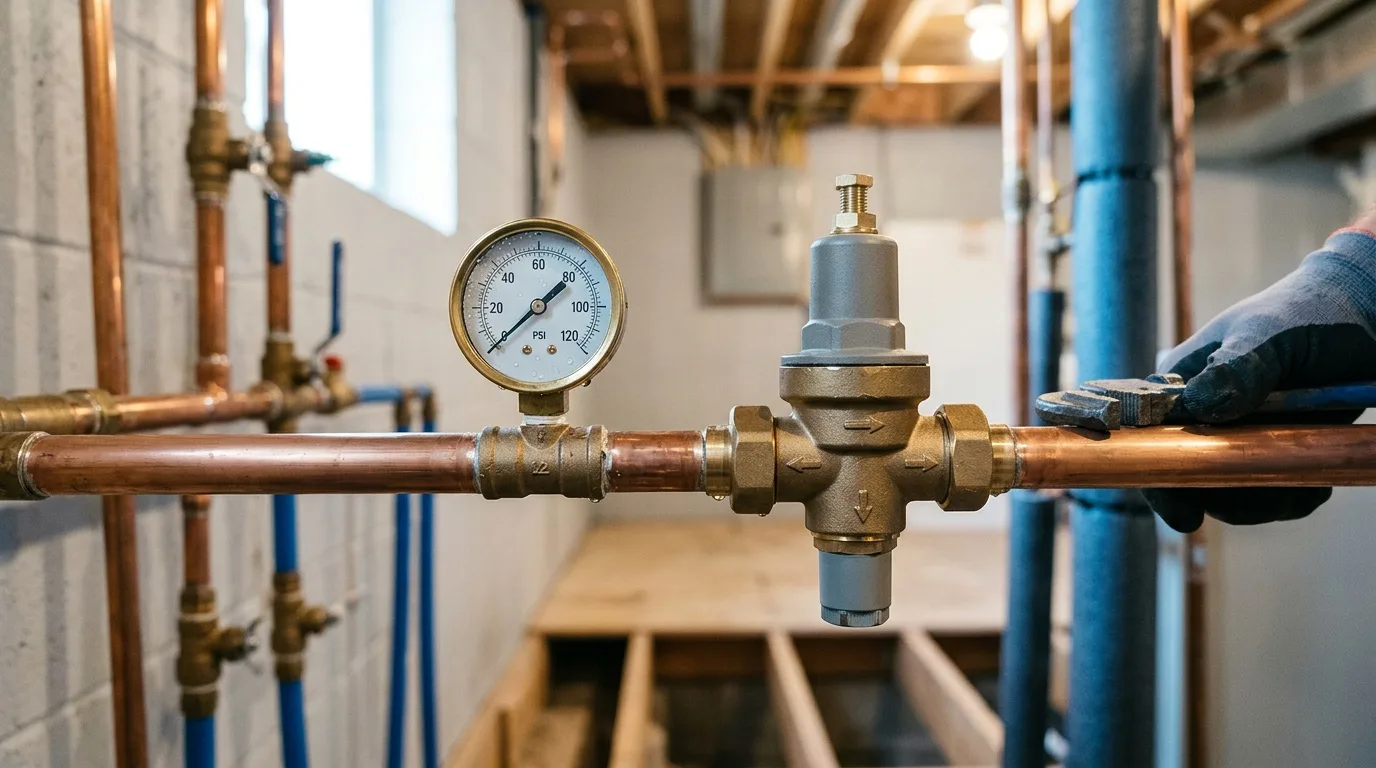
A pressure regulator (pressure reducing valve) is a device that lowers high water pressure in the house water lines. It protects connected equipment and other parts of the system from fast wear and failures. It keeps the set value on the house side even when the pressure coming in jumps.
The regulator works on a balance between the water pressure and a spring. When no water is flowing, the device is closed. When a tap is opened, the pressure on the sensing element (a piston or a diaphragm) drops. The spring then moves the valve, which opens the passage until the outlet pressure reaches the set value. The inlet pressure does not affect its position.
What else a regulator does in a water system:
- Less load on pipes and fixtures. It reduces stress on valves and piping and extends their service life.
- Less wasted water. Part of the water lost to pressure swings is saved.
- Protection from water hammer. It protects the plumbing and household appliances, including expensive ones, from the effects of water hammer.
- Less noise. It lowers noise in the pipes.
A pressure regulator protects the lines from the effects of water hammer, but it does not absorb water hammer completely - that is a myth. Where one appliance keeps banging, a separate arrestor next to it is still needed.
Piston and diaphragm regulators
Piston models are simpler in design, compact and cheaper. But they are subject to mechanical friction, which shortens their life, and they need cleaner water: dirt can disrupt the piston or put the regulator out of service. Diaphragm regulators are less sensitive to impurities in the water. With no rubbing parts, they are more reliable.
Who owns the regulator
Here in San Diego County, water districts point out that the regulator on the house side belongs to the customer: the homeowner installs and maintains it, and it is typically set around 50 psi.
Regulator Lifespan and Water Pressure Regulator Replacement
A pressure regulator can get clogged with rust and other debris present in the pipes. Solid particles are often the cause of failure. A clog keeps the valve from closing the water passage tightly, and that raises the pressure after the regulator. This is why a house that once had normal pressure can end up with high pressure again.
- Stuck adjustment. A common cause of instability is a seized adjustment, a clogged screen in front of the regulator, or a worn diaphragm.
- Worn diaphragm or spring. The regulation becomes unstable: it squeezes the pressure down, then lets more through, sometimes with noise.
- Leaks from the body. Leaks from the housing and higher water use are common signs of a faulty regulator.
A sediment filter in front of the regulator is often recommended, especially for piston regulators. The filter cleans the water of impurities and extends the life of the device itself, protecting it from sediment that over time can put it out of service. Service life also drops when the device does not match the conditions where it is installed: room temperature, water temperature and incoming pressure.
The most reliable way to check whether a regulator works is for a plumber to install gauges before and after it: the one in front shows inlet pressure, the one after shows outlet pressure. Repairing a regulator at home usually makes no sense. If the regulator clearly works incorrectly, and this is not caused by outside conditions, it is better to have a plumber replace it.
How to Adjust a Water Pressure Regulator
Adjustment is done after the regulator is installed, according to the specifications of the house system and the device's documentation. The working pressure is changed by adjusting the spring compression with a threaded adjustment screw. In general terms, a plumber does it like this:
- Close the fixtures. All taps in the house are shut off to avoid leaks and get an accurate setting.
- Crack one tap. One faucet is opened slightly so water runs in a thin, steady stream.
- Reach the screw. The cap over the adjustment screw on the regulator body is carefully removed.
- Turn the screw. The screw is turned in the direction the documentation gives for raising or lowering pressure; depending on the model, by hand or with a screwdriver or hex key.
- Check and repeat. The faucet is opened and the pressure checked; the adjustment is repeated until the desired value is reached.
- Close the cap. After adjustment the opening is covered again to protect the mechanism from dust and moisture.
Drying Out After a Pressure-Related Leak
If high pressure has already torn a supply line or a joint, shutting off the water is only the first step. Water that soaked into drywall, flooring and cabinets does not leave on its own, and wet materials left for days are where mold remediation in your home starts to come into play. When furniture and belongings have to be moved out of the wet rooms, pack-out and contents storage services keep them out of the way while the structure dries.
You can read more about our La Mesa team, see what local homeowners say in reviews, or browse more water and mold articles on the La Mesa restoration home page.